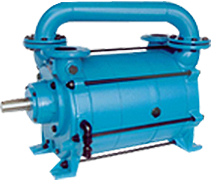
Liquid Ring Vacuum Pumps are used in different industrial areas to create process vacuum. In this equipment, a compression chamber seal is created by the rotation of a water-filled pump body and an eccentrically placed impeller. Usually, the sealant is made of water or another suitable liquid. These liquid ring vacuum pumps are a safe and reliable choice to manage dirty and critical gas/vapor services since it has contactless components and is easy to use.
A wide range of highly efficient Liquid Ring Vacuum Pumps by Pompetravaini and Gardner Denver Nash are available at PumpAir Solutions. They are the most well-known brands in the industry because of their innovative engineering and designs for a variety of vacuum pumps. These liquid ring vacuum pumps are ideal for a wide array of industrial applications because of their unparalleled efficiency and premium quality.
Specifications Of The Best Liquid Ring Vacuum Pumps
Suction Capacity
Small Vacuum Pumps – 60 – 10000 m3/hr.
Medium Vacuum Pumps – 10000 – 20000 m3 /hr.
Large Vacuum Pumps – 20000 – 40000 m3/hr.
Working Principle Of Liquid Ring Vacuum Pumps
The liquid sealant and impeller are the two components of a liquid ring vacuum pump that are most important for producing a vacuum. Water is the most often used liquid sealant. The vacuum pump’s impeller is situated between two port plates at an angle to the casing’s centreline. The centrifugal force produced by the impeller’s circular movement makes the gas become trapped in small areas. The liquid takes the form of a ring and leaves a vacuum area. Hence, because of the eccentric positioning of the impeller, the space becomes large and the process gas is drawn in through the suction slot.
As the impeller continues to rotate, the spaces decrease in size and the gas is compressed. Then the exhausted gas and residual water are separated and discharged through the discharge slot. The constant flow of cooler seal liquid replaces the older seal liquid and the process continues.
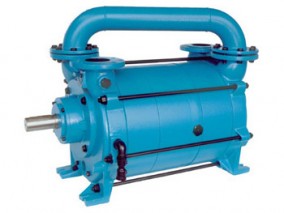
Product Specifications:

Product Specifications:

Product Specifications:

Product Specifications:

Product Specifications:
Vapor Condensation of Liquid Ring Vacuum Pumps May Produce a Capacity Bonus
When moist air or gas mixes with condensable vapors that enter the liquid ring vacuum pumps, the seal liquid, which is generally at a considerably lower temperature, cools them down. They therefore cool and combine with the seal liquid. These vapors now occupy less area compared to when they were a gas stream. This reduction in the volume yields a capacity bonus.
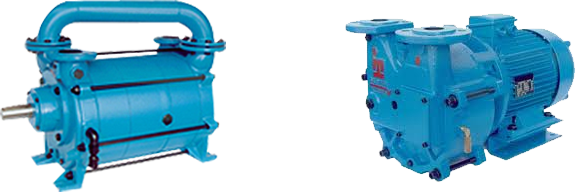
Their liquid ring design minimizes mechanical contact, reducing wear and ensuring long service life.
Yes, they are available in various material configurations to suit demanding and corrosive applications.
Yes, advanced models feature optimized hydraulic designs that improve efficiency and lower operating costs.