contentlrvppics

Operating principle of Liquid Ring Vacuum Pumps with Exhaust Valves

SKINCARE ESSENTIALS FOR HOLI
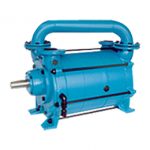
A Liquid Ring Vacuum Pump consists of a housing which contains Multi-bladed impeller. The impeller diameter is less than the housing diameter. The impeller is also mounted offset relative to the housing axis.

The flow of the liquid in the liquid ring vacuum pump (called service liquid) is allowed to run into the pump. When the impeller is rotated, the liquid spins to the outside of the housing to form the liquid ring (after which this technology is called liquid ring vacuum pump).

Liquid ring vacuum pumps must be supplied with a continuous flow of service liquid. This service liquid is required by the pump to form the liquid ring which seals the tips of the impeller vanes.

When there is high air flow through the pump, all exhaust port holes will be open. When there is low air flow (as will be the case when the pump is at maximum vacuum) only the holes at the top of exhaust port will be open. The variable area exhaust port design allows the pump to automatically adjust its compression ratio in relation to air flow through the pump.

Compared to liquid ring vacuum pump with fixed ports, the valved exhaust port vacuum pump allows:

  • Reduced power consumption at high air flows 
  • Better level of vacuum at low air flows 

Pompetravaini TRH Vacuum pumps, TRS Vacuum pumps, TRM Vacuum pumps, TRV and TRVX vacuum pumps are predominantly used in the industry for Vacuum condensing, Sterilization, solvent recovery, De-aeration, Vacuum filtration, distillation and centrifugal pump priming applications. 

As a truly independent engineering and supply company PumpAir Solutions represents a comprehensive range of Liquid Ring Vacuum pumps. We can offer Gardner Denver Nash liquid ring vacuum pumps and Pompetravaini liquid ring vacuum pumps. We also design & build superior purpose built vacuum packages customized to the specific requirements of our clients.

For more details visit https://www.pumpair.com.au/pompetravaini/

Be Inspired, Be Exceptional, Be Unique, Be Yourself

Share Now

Recent Posts

Frequently Asked Question

A liquid ring vacuum works by creating sealed compression chambers with a rotating liquid ring that draws in and evacuates gas.

Liquid ring vacuum pumps are widely used in chemical processing, food production, mining, wastewater treatment, and manufacturing.

Liquid ring vacuum pumps Australia are valued for their reliability, low maintenance requirements, and ability to handle wet or contaminated gases.
How to Operate a Vacuum Pump Safely

How to Operate a Vacuum Pump Safely? Just Follow our Guidelines!

SKINCARE ESSENTIALS FOR HOLI

Vacuum pumps have come a long way in terms of safety and ease of use. However, it is industrial equipment and should be assembled & used with utmost care and safety. Right from buying the correct pump to assembling, maintenance, and usage, it is important to follow the safety guidelines.
Be sure to pick a pump from a top brand that follows the government prescribed safety standards. Also, it is important to buy one that suits your industrial requirement. Our vacuum pump specialist at AirPumps Solutions can help you make the right choice.
Here are some quick steps for safe operation & maintenance of vacuum pumps:

Be Informed

  • Carefully read the given instructions for installing, operating, and maintaining the device.
  • Ensure that the personnel handling the device are technically adept to handle it.
  • Use the right pump for the right requirement.

Physical Safety Measure

  • Wear protective gear, including gloves & safety goggles while operating a vacuum pump.
  • Ensure that all vacuuming operations are done behind table shield or in a fume hood.
  • Ensure that the pumps are placed in a well-ventilated & open environment to allow heat & exhaust to escape.
  • Ensure that no flammable chemicals or combustible material, like paper/cardboard, is near the area of operations.
  • Make sure to warm the pump before operations with its inlet blocked.
  • Ensure that all parts of the pump that may get heated during operations are either inaccessible or equipped with protective guards.
  • Ensure that belt guard are in place during operations to prevent hands or loose clothing from getting caught in the belt pulley of the pump.
  • Ensure that the electrical cords and switches are defect-free.
  • Use the gas ballast in the early stages of the operations until the oil stops emulsifying.
  • Ensure that the vacuum tubing is thick enough to sustain the pressure.
  • Never check the suction levels by placing your hand on the suction inlet.
  • Never block the pump outlet.
  • Use short, large diameter hoses and in-line Schrader valve removers.

Chemical Safety Measures

  • Do not use any solvent that may damage the pump.
  • Ensure that the valve between the vacuum vessel & the pump is closed before shutting off the pump. Otherwise, it may suck oil in the system.
  • Make sure to keep a pan under the pump to catch any oil drips.
  • Regularly monitor & change the oil as required.
  • Dispose of the used oil correctly as a hazardous material.

Regular Maintenance

  • Allow the pump to cool down before starting any maintenance procedure.
  • Always keep the pump, motor, and the cooling fans clean to avoid overheating.
  • Record oil change dates and keep track of the pump’s maintenance schedule.
  • Regularly check and replace old tubing.
  • Do not leave emulsified oil in the pump for a long time as it may damage the pump.
  • Always remember to remove the refrigerant completely to avoid any seizures in the motor.
  • Always cut the power supply to the motor before initiating maintenance.

Each pump comes with instructions that need to be followed very carefully to ensure safe operations. For any more questions, be sure to reach PumpAir Solutions www.pumpair.com.au  Ph 02 90115344.

Share Now

Recent Posts

pumpair

Types of Industrial Vacuum Pumps

SKINCARE ESSENTIALS FOR HOLI

While all vacuum pumps essentially perform the same function of removing air & gaseous molecules from a restricted chamber, it is vital to pick the right one for your industrial usage.
Let us look at the various types of industrial vacuum pumps, based on their functioning, and their applications.

Positive Displacement Vacuum Pumps

These are the most commonly used vacuum pumps in Australia and are used to build low-volume vacuums. They work by pushing the liquids and the gases in the chamber into a cavity in the pump, which is then sealed. Thus, the vacuum is created in the chamber, and thereafter the cavity contracts and releases the trapped gases or liquids into the atmosphere. Liquid Ring Vacuum Pumps, Dry Running Claw Vacuum Pumps, and Rotary Vane Vacuum Pumps are some of the best examples of Positive Displacement pumps. These are used in a range of industries, varying from food & beverages to Petro-chemicals, Ceramics, and Oil & Gas industry.

Momentum Transfer Vacuum Pumps

As the name goes, these pumps use momentum or kinetic energy to displace the liquid or gaseous molecules from a confined chamber. Thus, creating a vacuum. Momentum Transfer Pumps generally work along with Positive displacement pumps to create high volume vacuums. They may further be classified as Diffusion Pumps and Turbomolecular pumps. While diffusion pumps create the momentum by shooting jets of oil along with the gaseous molecules, Turbomolecular pumps create the same momentum using high-speed fans.

Entrapment Pumps

The most effective and often used to create ultra-high-volume vacuums, Entrapment Pumps, apply various chemical reactions to achieve superior vacuums. Also known as capture pumps, these pumps use either supercooling methods or electrical fields to stimulate condensation and turn the gaseous molecules to a solid or absorbed state. Working in conjunction with Positive Displacement and Momentum Transfer Pumps, Entrapment Pumps are super-efficient vacuum creators.

Regenerative Vacuum Pumps

A Regenerative Vacuum Pump generates a vacuum by spinning, oil-free impellers causing centrifugal action to accelerate air as it passes through its impeller blades. It works as a multi-staged compressor, with each blade-to-blade regeneration of gaseous molecules resulting in a slight pressure increase. Thus, creating a vacuum. These pumps work based on the Non-positive Displacement Method and are perfect for moving large volumes of air at low pressures or vacuums.
Well, here are the four main kinds of pumps used in industries for creating various levels of vacuum. For any more information, please reach Pump Air Solutions www.pumpair.com.au  Ph 02-90115344 Our industry experts shall be happy to assist you in choosing the most suitable vacuum pump to meet your business needs.

Share Now

Recent Posts